How China Plans to Dominate World Trade Long After Trump
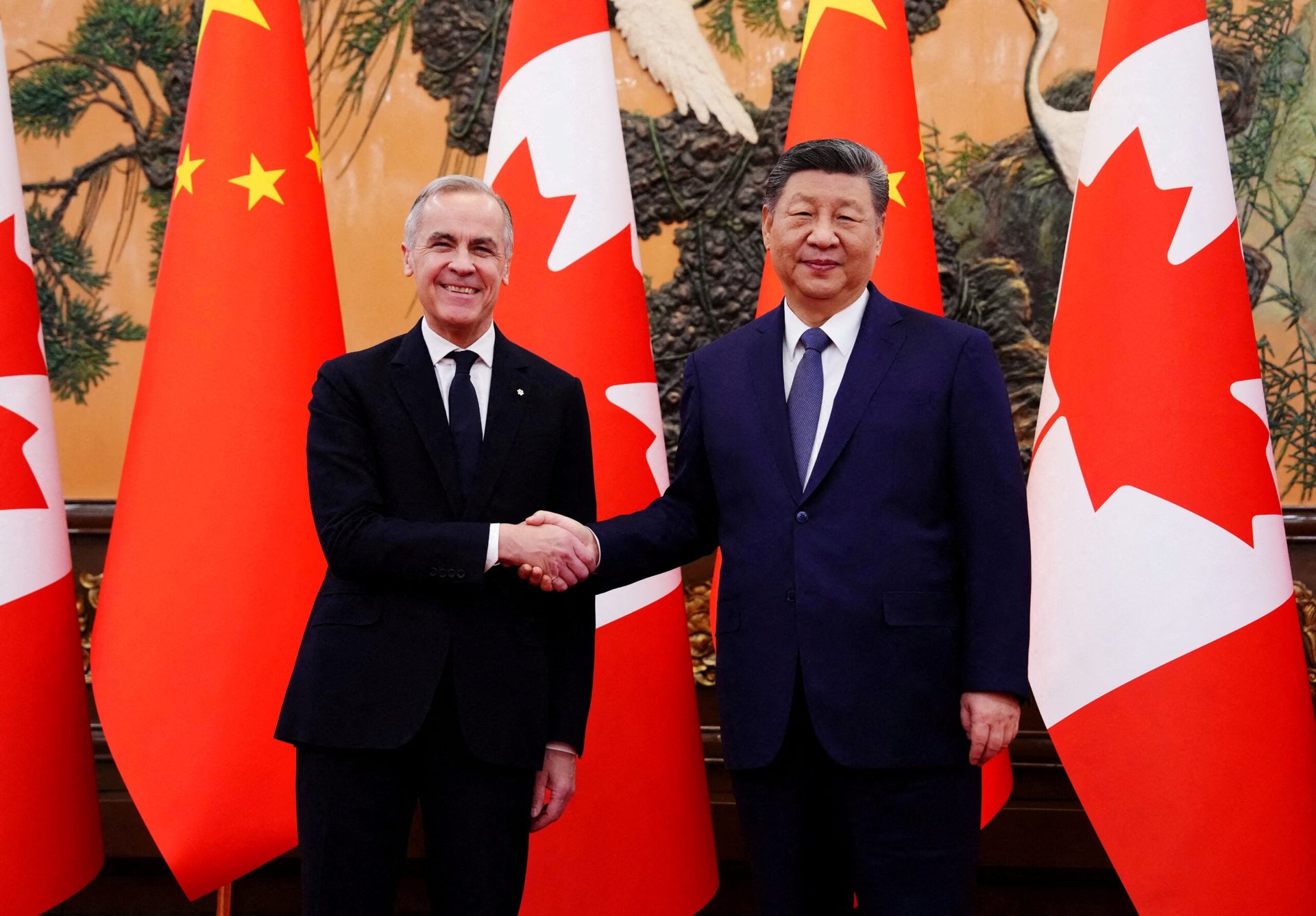
China sees an opportunity to turn President Donald Trump’s tariffs to its advantage by restructuring international trade in ways that will protect its $19 trillion economy from future US pressures.
Beijing is using the uncertainty created by Trump to try to integrate China’s huge manufacturing base into the world’s largest economies, including the European Union, the Gulf States and the trans-Pacific trade agreement, Reuters examines. The push involves accelerating efforts to reach a total of about 20 trade deals, years in the making, despite widespread concerns about China’s overproduction, uneven market access and soft domestic demand.
A Reuters review of 100 Chinese-language articles by government-backed trade scholars written since 2017 reveals a systematic push by China’s policy advisers to reverse US trade policy and undermine Washington’s containment strategy.
China is now implementing that program. The deal reached with Canada during Prime Minister Mark Carney’s January visit to Beijing — which slashes tariffs on Chinese electric cars — was the first of many aimed at undermining American power, according to interviews with 10 people, including Chinese officials and trade officials.
“Don’t interrupt your opponent when he makes a mistake,” said one Chinese official of Trump’s disruptive trade plan.
The review, drawn from more than 2,000 trade strategy papers commissioned by the Chinese Academy of Social Sciences (CASS) and Peking University, which advises top leaders, shows policy insiders widely accept that painful structural change is the price to be paid for China’s long-standing dominance of world trade. The contents of the papers are reported here for the first time.
If successful, Beijing could reverse more than a decade of US trade policy by placing itself at the heart of a new China-shaped system, two Western officials said.
“The Chinese have a great opportunity now,” said Alicia Garcia Herrero, an executive at the Bruegel think tank.
China’s commerce ministry did not respond to a request for comment on Beijing’s strategy.
Asked about China’s approach, the US official told Reuters that it is not surprising that countries with large trade surpluses want to maintain globalization.
“President Trump is fixing the problems globalization has created for the United States while other countries are trying to double down on globalization as access to free markets in the United States goes away,” the official said.
Building blocks
The change in Chinese tone reflects its statistics. A year ago, Beijing was promoting Mao Zedong and his ability to defend himself against the West in the Korean War through military propaganda.
Now, as China prepares to host Trump in April, its politicians are traveling the world urging trading partners to join it in defending international citizenship and open trade.
In January, China sent its top diplomat to tiny Lesotho – where Trump began imposing a 50% tariff – to pledge development cooperation. On Saturday, state media said China would apply tariffs to imports from 53 African countries. Meanwhile, China is pushing AI-powered cultural programs to its neighbors and working to overhaul the digital infrastructure that supports trade.
These steps underscore the goal outlined in the policy papers: to embed China so deeply in international trade that its partners cannot isolate it under US pressure.
“In the fight against the US’s strategic competition with China, ‘breaking the alliance’ should be China’s main focus,” wrote Ni Feng, a fellow at CASS’s Institute of American Studies, in 2024.
Chinese officials are now working to speed up stalled trade talks. Since 2017, China has been negotiating with countries including Honduras, Panama, Peru, South Korea and Switzerland.
“We are willing to negotiate with countries and regions interested in trade and investment through trade and regional agreements,” Commerce Ministry spokesman He Yongqian told Reuters during Carney’s visit, without elaborating.
Chinese Foreign Minister Wang Yi surprised European negotiators in November by raising the prospect of a free trade deal with Brussels during talks with his Estonian counterpart.
A month later, Wang pressured the Gulf Cooperation Council to conclude protracted negotiations on a free trade agreement. In January, British Prime Minister Keir Starmer agreed with Chinese leader Xi Jinping to launch a study into the possibility of a trade deal that could reduce barriers for British firms. German Chancellor Friedrich Merz said he would seek a “strategic partnership” with China during a visit next week.
China’s commerce minister Wang Wentao has made joining the Comprehensive and Progressive Agreement for Trans-Pacific Partnership (CPTPP) a top priority. The deal stems from the US-backed Trans-Pacific Partnership, which was developed in part to counter China before Washington pulled out in 2017.
But China’s huge trade surplus makes it difficult to listen. Some member states are concerned that Chinese manufacturers may take advantage of improved market access to funnel cheaper goods abroad, while China’s domestic demand remains weak.
Wendy Cutler, the Obama administration’s chief negotiator on the Trans-Pacific Partnership, acknowledged Beijing’s openness to trade and international cooperation but said China needs to go beyond talk.
“And with the huge trade imbalance, and some of the enforcement measures now taking place in countries like Japan, it’s hard to see how they’re going,” Cutler told Reuters.
Europe’s top trade official dismissed Beijing’s move as “pure Chinese propaganda,” saying Brussels has no plans for a trade deal.
Chinese advisers are undaunted. Speaking to Reuters, one noted that the EU and China negotiated a landmark investment deal for 2020 during Trump’s first term. The agreement, however, was put on hold until 2021 before it could come into effect amid a dispute over human rights sanctions.
Lessons learned
Some Chinese advisers argue in the papers that Beijing should learn how Washington has “armed” international institutions to contain China, and exploit the openings created by Trump’s willingness to leave or sideline international organizations such as the World Trade Organization.
Others say Beijing should focus on influencing global standards in areas such as intellectual property through initiatives such as Xi’s Belt and Road initiative and China’s membership in the Regional Comprehensive Economic Partnership, which accounts for about 30% of the world’s GDP.
China is now implementing those ideas.
Its newly developed agreement with Southeast Asian regions, for example, focuses on AI-driven and digital trade, where China hopes to gain an early advantage.
Indeed, China’s vision for the processing of goods for sale can be seen in the “Port of Friendship” on the border of Vietnam, where the state media claims that home-grown AI solutions have reduced waiting times by 20%, enabling faster delivery. Reuters could not independently verify the claim.
A billion dollar sum
However, the risk that China’s $1.2 trillion trade surplus poses to our partner’s manufacturing sectors is not easy to ignore.
Pascal Lamy, former WTO director-general and EU trade commissioner, said Chinese firms were sending more goods to Europe than the bloc could take.
“It’s a mystery that, given the nature of the regime, given the nature of the collective intelligence, how come they failed to succeed in rebalancing their economic model?” he said.
Not everyone sees closer ties with China as an easy way to curb dependence on the US
Stephen Nagy, who heads the China project at the Macdonald-Laurier Institute in Ottawa, said Carney’s tariff cut deal with Xi appears designed to build momentum ahead of negotiations on the US-Mexico-Canada trade agreement (USMCA).
“I think his bet is wrong,” he added, predicting that Trump would not budge.
Carney said Canada respects its USMCA commitment not to pursue free trade agreements with non-market economies. His office did not respond to a request for comment.
Mexico, on the other hand, is wary of risking access to the US market by getting too close to China.
“We don’t see the need for a free trade agreement with China right now,” said a Mexican trade official. “We are already in the CPTPP and have 60% of the world’s combined GDP.”
Beijing’s trading partners really need China to revive its spending, said Fred Neumann, chief Asia Pacific economist at HSBC.
Wang, China’s commerce minister, said growing imports is a priority as Beijing prepares to launch its five-year plan next March, which includes a commitment to increase consumption as a share of GDP.
But rebalancing is a long-term task. Trump has three years left in office, and the next administration could return to building alliances to contain China.
China must “deeply study the concept of US actions in international institutions and the next steps it may take to better respond to future strategic attacks,” Zhao Pu, then of Renmin University and now a researcher at CASS’s Institute of American Studies, wrote in 2023.
(Reporting by Joe Cash in Beijing; additional reporting by Casey Hall in Shanghai and Andrea Shalal in Washington; editing by Kevin Krolicki and David Crawshaw.)