Green Zones Report: 3 Okinawan Secrets to Long-Term Emotional, Mental, and Physical Health

Dan Buettner is the founder of Blue Zones. Blue Zones is an organization dedicated to helping people live longer, better lives by sharing the lessons of longevity culture. You may have heard of him recently as he now stars in a new NetFlix series, Live at 100, Secrets of the Blue Zones. In episode 1 he travels to the Japanese island of Okinawa to learn about Ikigai.
However, Okinawans actually have many traditions that reflect the proven concepts of a long and happy life. Below we delve into the concepts of: ikigai, moai, hara hachi bu, and more.
Who Are Okinawans And What Do They Know About Longevity?
Okinawa is an island in the South of Japan where the East China Sea meets the Pacific Ocean. It is a beautiful hot spot with some of the longest living people in the world. On average, men live up to 84 and women up to 90. There is also a very high concentration of centenarians – people aged 100 or older. Perhaps most surprising is that even the oldest Okinawans are considered healthy and have the emotional, physical and mental capacity to live and work independently.
So, what is their secret? Researchers say Okinawa’s secrets include: ikigai, moai and hara hachi bu.
Let’s discover these three powerful concepts and how they apply to your retirement.
1. What is Ikigai?
Google translates Ikigai from Japanese to English as “reason for living.” Again, this is probably a good explanation, if simple.
Living a long life seems to require having a sense of purpose well into old age. At least one international study found that people with a sense of purpose in life have a lower risk of dying from heart disease. Those who feel purposeful tend to have healthier lives. Also, they are motivated and strong, which protects them from stress and burnout.
So, how do you find your kigai / reason for living?
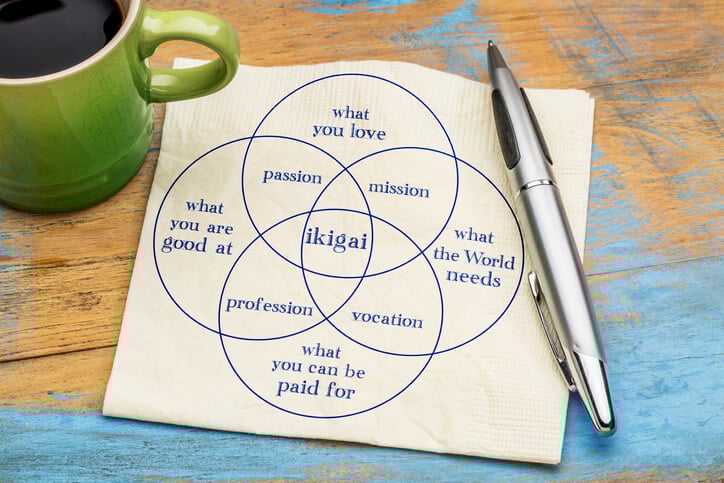
The Japanese formulation of ikigai describes the intersection of what you love, what you know how to do, what the world needs and what you can get paid for.
Some important qualities of ikigai:
- It’s a challenge for you. Your kigai should be something you need to strive to control.
- Ikigai is your choice, not something forced upon you.
- It involves a commitment from you
Here are a few resources to learn more about ikigai:
- Book: Ikigai, The Japanese Secret to a Long and Happy Life by Hector Garcia and Francesc Miralles
- Video: Ted Talk, Ikigai, Tim Tamashiro
- Video: Ted Talk, Don’t Wait to Find Your Ikigai, Gangadharan Menon
2. What is a Moai?
In Japanese, moai refers to a group of lifelong friends. It also means a social support group that provides social, financial, health, or spiritual support.
The concept of moai was popularized in the United States by Buettner.
An article on the Blue Zones website describes moai in Okinawa as follows:
The name originated centuries ago as a means of financial support for the village. Originally, moai were created to mobilize the resources of the whole village to carry out activities or public works. If someone needed money to buy a property or take care of an emergency, the only way was to pool money in the property. Today the concept has been expanded to become a social support network, a cultural tradition of built-in friendship.
In small communities throughout Okinawa, friends “meet for a common purpose” (sometimes daily and sometimes several days a week) to gossip, catch up on life, and share advice and even financial help when needed. These groups call them their moai.
Traditionally, groups of about five young children are paired together and that’s when they commit their lives to each other. Like their second family, they met regularly with their moai to work on games and collect resources. Some moai have lasted over 90 years!
You may not be able to have a moai with a strict interpretation, but you should strive to have a close-knit group of friends and meet regularly.
3. What is Hara Hachi Bu?
Compared to kigai and moai, hara hachi bu is more straightforward and easier to apply in your life.
Hara hachi is a dietary rule that says you should eat until you are 80% full. By limiting your food intake closely, but not excessively, you eat fewer calories, but not less than you actually need.
You see, your brain is about 10-20 minutes behind your stomach. So, if you stop eating when you feel 80% full, you are actually full. Practicing hara hachi bu, the average Okinawan man eats only 1,800 calories a day, compared to the average American who eats close to 2,500 calories.
Bonus: Some Longevity Lessons from Okinawans
Researchers believe that kigai, moai, and hara hachi bu are the three main reasons why Okinawans live so long and so well.
Other participants include:
A plant-based, more varied diet: Okinawans eat more vegetables than most people (especially green and yellow), as well as grains, tofu, fish, and other grains. They eat very little sugar, and very little meat, milk or eggs.
In a CNN interview with Sanjay Gupta, Craig Willcox, author of the book “Okinawa Program”, explained that the people of Okinawa “used to eat seven different fruits and vegetables and 18 different meals a day, as well as more than 200 different foods and spices in their meals.
Vegetable foods are naturally full of antioxidants, flavonoids, fiber, nutrients, and are naturally low in calories and anti-inflammatory.
Job: Staying active doesn’t mean running 10 miles a day or breaking a sweat in the gym. The Okinawan concept of exercise makes physical activity a part of everyday life.
Almost all Okinawans are active hikers and gardeners. Gardening is a daily physical activity that encourages extensive movement. Okinawans are also very good at hiking, cycling and even participating in martial arts. In addition, their homes have limited furniture and they eat their meals sitting on tatami mats on the floor. Ups and downs increase flexibility and strength.
Sunlight: Because of their tropical climate and active outdoor lifestyle, Okinawans benefit from year-round exposure to vitamin D.
Outside Magazine recently asked, “Is Sunscreen the New Margarine?” It turns out that people with low levels of vitamin D – a hormone made by our skin with the help of sunlight – have very high levels of almost every disease and disorder imaginable. Also, vitamin D supplements do not have the same health effects as sun exposure itself.
Although skin cancer is a risk factor from sun exposure, it may be a lesser evil than vitamin D deficiency.
Here are a few ideas on how to make warm weather a reality in retirement.
Make Longevity a Key Factor in Your Retirement Planning
You don’t know how long you will live, but the answer to this question can be an important factor in planning for a secure future.
In the Boldin Retirement Planner you can try different life expectancy to see if your savings will last longer. However, it can be a good idea to explore ways to have enough money for life – income that lasts as long as you do – however long that may be. Sources of lifetime income include Social Security and other pensions. You can also turn savings into guaranteed income for life by purchasing a lifetime annuity.
The tool is convenient for planning because it includes a complete set of information related to retirement and allows you to customize everything.
The post Blue Zones Report: 3 Okinawan Secrets to Emotional, Mental, and Physical Longevity appeared first on Boldin.